A whole day on the M2F Teaching Course learning how to teach people to go from Rounds to Plain Hunt? Surely, we thought, you just get a band of ringers who know what they’re doing, put a learner in the middle (with a pilot) and shout, ‘go plain hunt’. How wrong we were. If you give your learner the foundation skills to do plain hunting, then they are much more likely to enjoy learning how to do it and even more likely to carry on ringing.
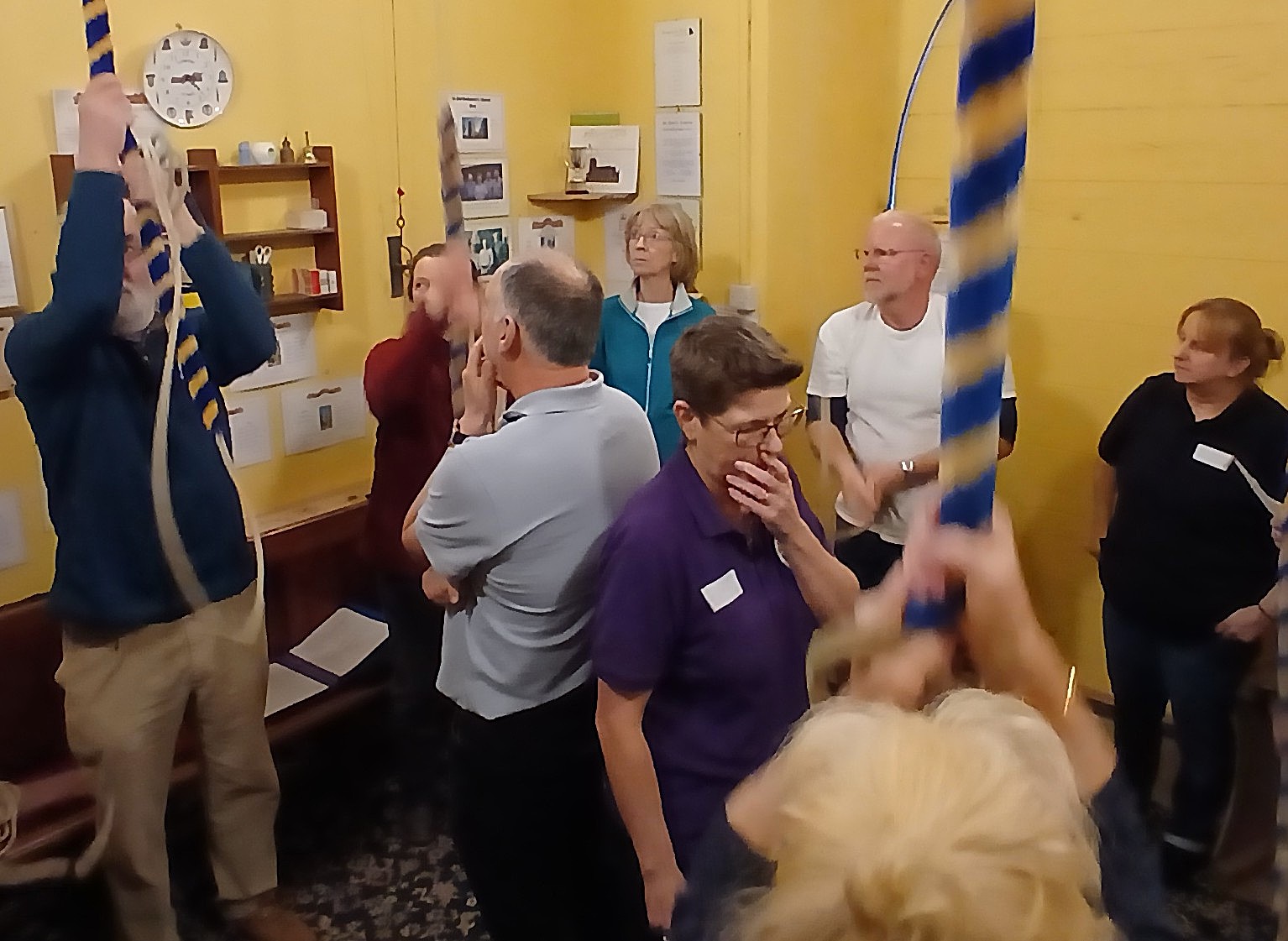
The course began with coffee and introductions, followed by a session on teaching foundation skills. We made up two bands of six, divided largely on the geographical location of our home Towers, which introduced a healthy dose of friendly competition at the foundation skills. We tried one whole pull and stand in rounds and then moving one bell to the right and repeating this like some sort of slow-motion line dancing until everyone had rung every bell in the Tower. We managed a couple of very pleasing renditions of Twinkle Twinkle Little Star. When we’d managed to ring our rounds tidily the conductor shouted ‘Switcharoo’ and we attempted the switch to reverse rounds. We played Twizzle to improve our listening skills; this is the exercise where each ringer in turn moves around their rope to face out of the circle.
After coffee and some excellent cheese scones our 6 ringers each picked a lottery card containing one of the numbers 1 to 6 defining their place in the ringing order and without showing their number to the rest of the ringers, the conductor shouted, ‘look to, bell’s going, she’s gone’ and all ringers pull off in their lottery ticket designated place order – largely fine. We then get the other team standing out to call us back into rounds – largely not fine, but I believe this would be achievable with more practice. In some of the theory sessions in the morning we covered explanation of ringing jargon and ‘taught’ each other the theory and practice of ringing call changes and plain hunt. Sometimes the explanations of these things, even to someone who knows what they are doing can be very entertaining (although possibly describing how to fly a Boeing 747 would be easier).
After a fine lunch we progressed to a practical session on Exploring Kaleidoscope Ringing and the Mexican Wave. We followed this with an interesting discussion on why people ring based on the results of the North East Branch Ringer Development Questionnaire and it turns out there are as many reasons for ringing as there are ringers, so keeping your band on side all of the time can be a bit of a challenge.
After tea, the last practical session of the day focussed on how to use various methods to help your learners just hunt to seconds and thirds – after concentrating all day on lots of new stuff we did struggle a bit with this practical exercise, but we definitely know now what areas we need to focus on – the ‘method’ known as penultimate doubles is on my list for further practice.
Finally, we were amongst some of the privileged few to get a preview of the new SmartRinger website which is looking very nice. In conclusion then, this course was much better than I was expecting, and I would highly recommend it to anyone who has anyone in their tower who is interested to learn new things.
As this was the last course that Les Boyce taught before handing over the responsibility for this to Alena Wardle, we would like to thank him for all his work teaching us how to teach and his huge contribution (which cannot be underestimated) to ensuring that the skills of ringing are passed on to future generations. Thanks also to Sheila who has supported him on these courses whilst we strive to improve our skills. We wish you both all the best in future.